An international launch needs an understandable offer and a locally relevant use case. Social distribution does not replace adapting the post-click journey.
01STORY BRIEFThe idea in three screens.3 SCREENS

Launching in the US from abroad: start with the scene.
An international launch needs an understandable offer and a locally relevant use case.
Before producing a series, check that target-market visitors can understand value, pricing and product terms. Choose a narrow use case for initial content. Localized accounts will not rescue a page addressing unfamiliar constraints or an unavailable offer.
Follow the click into the product: availability, language, displayed currency and signup experience. A video promising an immediate action should not lead to a page imposing a different expectation. This review sometimes reveals that the main launch problem is promise-to-destination consistency rather than account infrastructure. Fixing that mismatch gives any subsequent distribution experiment a clearer proposition to evaluate and a more meaningful commercial outcome to observe.
Start with one believable American use case.
A US launch becomes easier to review when the brief names a specific situation rather than an enormous market. A college lecture, a freelance client call and a team meeting are different scenes even when they use the same product. Check the vocabulary, expected workflow, currency and product availability that the scene implies. Ask someone familiar with the situation to identify what feels implausible before scaling production.
A launch small enough to learn from
- 01Scene
One concrete use case with checked local assumptions.
- 02Pilot
A limited set of original executions and a consistent window.
- 03Review
Comprehension, qualified interest and product fit considered separately.
Editorial model: a way to reason about the process, not measured platform results.
Then run a bounded launch with a defined observation window. Track whether the creative promise matches the landing page and whether the product can fulfil the use case. Keep audience geography, qualified visits and later purchases separate in the report. A post can be understandable to US viewers without predominantly reaching them, and a visitor can arrive without becoming a qualified prospect. The launch should help discover which assumption is wrong, rather than forcing every disappointing result into a story about the account’s origin or the minute it was published.
From the idea to the actual workflow.
Product screens, documented tools and a practical way to connect them.
Preview an account with three video slots before committing credits
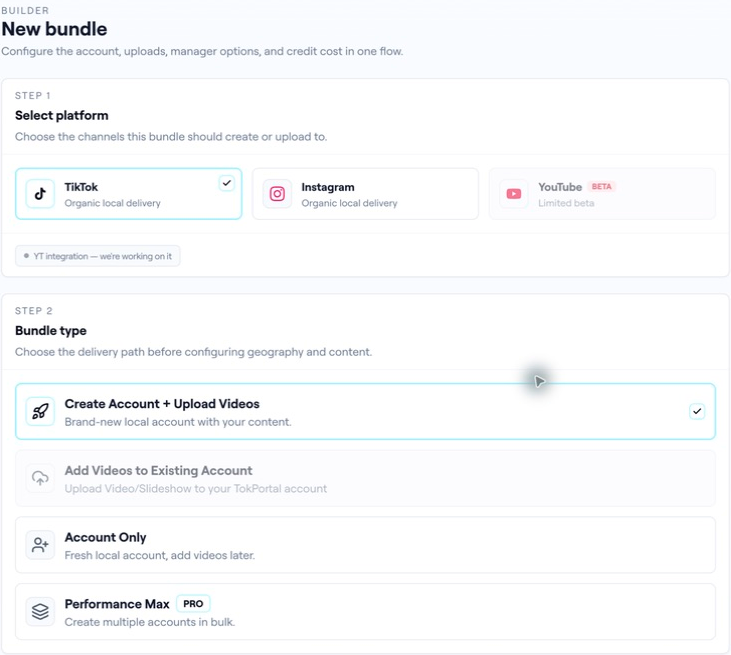
The archived builder shows account and video-package choices. This sample MCP request previews a package with one account and three video slots; it does not upload three video files.
POST /api/ext/bundles{
"tool": "tokportal_create_bundle",
"arguments": {
"dry_run": true,
"body": {
"bundle_type": "account_and_videos",
"platform": "tiktok",
"country": "USA",
"videos_quantity": 3,
"edits_quantity": 0,
"wants_advanced_warming": false,
"auto_finalize_videos": false
}
}
}This is a sample request, not an executed order or a price quote. In REST, the equivalent simulation uses X-TokPortal-Dry-Run: true. Live creation debits credits immediately; the preview is the place to inspect the actual workspace-specific price.
- 01Read the quote
Read the quoted credit fields and cost_breakdown returned by the current contract. A simulation does not debit the live balance.
- 02Keep simulation separate
Returned simulation IDs are synthetic and cannot be reused in live requests. The simulation does not retain cross-call objects.
- 03Review the package
auto_finalize_videos is explicitly false here. Check the current review-window rules before any live execution.
Prepare the actual video slot, not just the caption
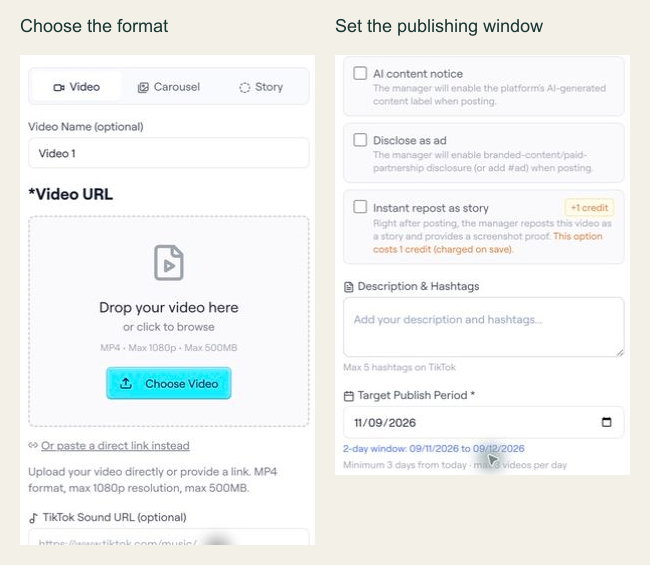
In the archived editor capture, the interface shows Video, Carousel and Story options, plus a target publishing period. The API example below is a separate documented slot-configuration preview; the screenshot alone does not establish the API contract.
PUT /api/ext/bundles/{id}/videos/{position}{
"tool": "tokportal_configure_bundle_video",
"arguments": {
"id": "<real-bundle-uuid>",
"position": 1,
"body": {
"video_type": "video",
"video_url": "<public_url returned by your video upload>",
"description": "A practical example of organising freelance subscriptions.",
"target_publish_date": "<valid future date: YYYY-MM-DD>",
"ai_content_disclaimer": false,
"auto_publish": false
},
"dry_run": true
}
}Replace the marked values with an authorized real bundle, a media URL you control and a valid future date. This is a dry-run template, not an executed campaign. The archived UI shows a two-day period for that captured example; use the current API validation response to determine the dates accepted for your own request.
- 01Choose the correct media fields
A video needs video_url and description. A TikTok carousel instead needs carousel_images and tiktok_sound_url.
- 02Use a valid window
Allow at least three days while account creation is pending, or one day for delivered/existing accounts. Check the current response and limits.
- 03Read the preview result
Check the simulation markers and date validation. If INVALID_DATE includes details.earliest_allowed, use that returned limit to revise the proposed date. Never copy preview IDs into live requests.
“Launching in the US from abroad: start with the scene.”
02FIELD KITFrom concept to practice.2 SCREENS
Review the complete journey in local context.
Adapt this to your audience, budget and test scope.
Put it to work.
- 01Review the complete journey in local context.
- 02Connect every angle to a relevant destination.
Notes & sources.
The limit. A US audience alone is not evidence of paying demand.
Further reading is linked throughout this article. Worked examples explain a process; they are not campaign results.
THE ORGANIC CLUB is an editorial project initiated by TokPortal. That relationship is separate from the evidence behind claims. Editorial signatures and image credits are explained in our policy. Our editorial policy →