Account-Generated Distribution (AGD) organizes differentiated social accounts as organic distribution infrastructure. More accounts only make strategic sense when audiences, voices and creative work also differ.
A product becomes part of an ordinary moment
Look at how quickly the example establishes a reason to keep watching. That is the piece an AGD network needs to reproduce across distinct editorial identities. The public post shows a creative choice; it does not reveal the creator’s account portfolio or prove incremental sales.
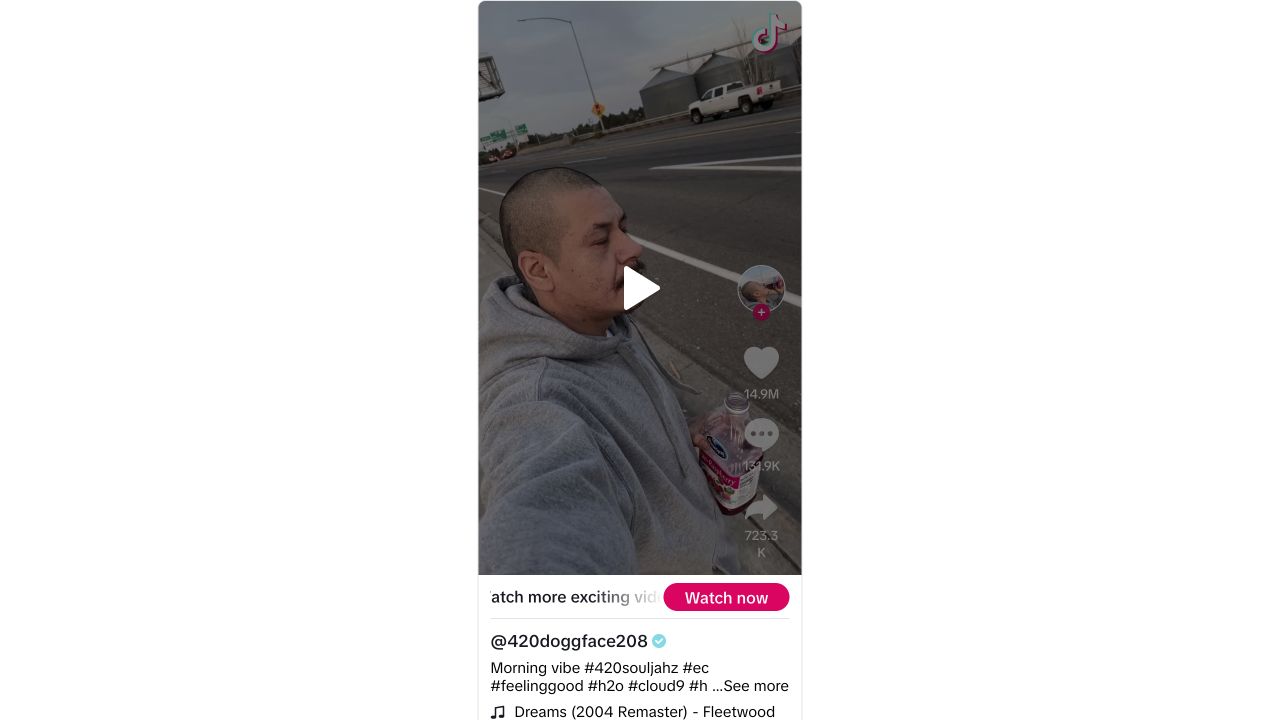
Nathan Apodaca skateboards while drinking Ocean Spray cran-raspberry juice and lip-syncing Fleetwood Mac’s “Dreams”. The player thumbnail visibly shows the creator, roadside setting and bottle.
Make the product legible inside an activity people understand. This is a useful study of context and cultural participation, not a recipe for manufacturing spontaneity.
Source & observation notes
Establishes a concrete creator-led moment later discussed by TikTok. It cannot isolate the sales contribution of this one video or guarantee repeatability.
Source-described; full video not independently watched; public embed thumbnail and identity checked Source checked 2026-09-08. Source 1 ↗
01STORY BRIEFThe idea in three screens.3 SCREENS

The next advantage is knowing where an idea deserves to live.
Everyone can produce. Almost nobody knows how to distribute. Welcome to the other side of the iceberg.
The pitch fits in a browser tab: one generator, a few prompts, fifty videos. The problem starts after export. Who watches? Why should that person stop at this account instead of the next one? Production has a button. Distribution still needs a reason to exist.
A brand account is often asked to reassure, sell, entertain, recruit and explain. Every post negotiates with the others. AGD separates those jobs. One account explores student frustrations; another challenges work habits; a third demonstrates a product in context. One company, three editorial promises.
The trap is reading this architecture as a volume recipe. Thirty accounts running the same edit do not represent thirty ideas. They mostly multiply coordination, repetition and unanswered questions. Diversification lives in what a viewer receives, not in the number of rows in a spreadsheet.
AGD is a proposed framework drawn from the TokPortal blueprint, not an academic consensus or a reach guarantee. Its value depends on the experiments it helps run. The useful question is whether a network reveals something that one account would hide. Can the signal be connected to an angle, an audience or a format?
Build a small network whose differences you can explain. Document the failures alongside the breakout posts. And keep a commercial measure next to views: somebody enjoying your edit does not necessarily have a problem your product solves.
The network should create information, not just inventory.
The seductive spreadsheet has one row per account and one column per day. Fill the cells and it looks like a distribution system. But the empty column is usually the important one: why would someone follow this account instead of the other nineteen? Start there. An account for students revising for exams and an account for researchers managing citations can sell the same note-taking product while earning attention for entirely different reasons. Their comments should sound different. Their demonstrations should solve different moments. Their useful vocabulary should diverge before their publishing schedules do.
From a pile of accounts to a useful network
- 01Audience
Name a specific situation, not a demographic bucket.
- 02Promise
Give this account a reason to exist without the product link.
- 03Learning
Record what changed in qualified attention, not only output.
Editorial model: a way to reason about the process, not measured platform results.
Treat the first network as a small editorial portfolio. Give each account a promise, a recognisable format and a question the team wants to answer. Then keep a record of failed ideas as carefully as the successful ones. If a tutorial attracts fewer views but produces people asking about the exact workflow your product solves, that may be more valuable than an unrelated joke. This is not permission to declare every low-view post a strategic success. It is a reason to define success before looking at the graph, and to connect distribution decisions to what the audience actually does next.
Here is the uncomfortable part for a product team: an excellent feature can remain culturally invisible. People do not encounter a roadmap. They encounter a person showing a task, an argument in a comment section, a ridiculous joke or an example that makes a problem suddenly recognisable. Distribution begins in those encounters. The account is useful when it has a reason to participate that survives beyond this week's launch. An account about the daily frustrations of independent editors, for example, can publish useful observations even when the product has nothing new to announce. That is an editorial asset. An account that only repeats release notes is a noticeboard with a username.
The Ocean Spray moment below is worth studying precisely because it resists the usual growth recipe. In the documented post, the bottle belongs to an activity and a mood; the viewer is not first asked to accept a marketing claim. That does not mean a brand can manufacture the same spontaneity on command. The transferable question is smaller: where does the product naturally enter something the audience already cares about? Start there, then make an original demonstration. The infrastructure matters after the idea has earned a place in the feed: getting the right asset onto the right account, preserving its context and learning from what happens next. Buying more output capacity before answering that question only makes the noticeboard bigger.
From the idea to the actual workflow.
Product screens, documented tools and a practical way to connect them.
Preview an account with three video slots before committing credits
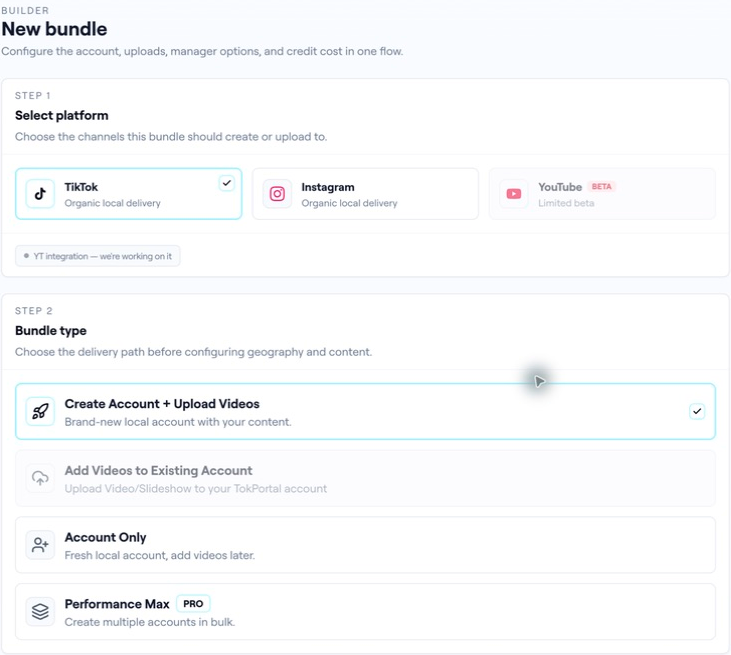
The archived builder shows account and video-package choices. This sample MCP request previews a package with one account and three video slots; it does not upload three video files.
POST /api/ext/bundles{
"tool": "tokportal_create_bundle",
"arguments": {
"dry_run": true,
"body": {
"bundle_type": "account_and_videos",
"platform": "tiktok",
"country": "USA",
"videos_quantity": 3,
"edits_quantity": 0,
"wants_advanced_warming": false,
"auto_finalize_videos": false
}
}
}This is a sample request, not an executed order or a price quote. In REST, the equivalent simulation uses X-TokPortal-Dry-Run: true. Live creation debits credits immediately; the preview is the place to inspect the actual workspace-specific price.
- 01Read the quote
Read the quoted credit fields and cost_breakdown returned by the current contract. A simulation does not debit the live balance.
- 02Keep simulation separate
Returned simulation IDs are synthetic and cannot be reused in live requests. The simulation does not retain cross-call objects.
- 03Review the package
auto_finalize_videos is explicitly false here. Check the current review-window rules before any live execution.
“The next advantage is knowing where an idea deserves to live.”
02FIELD KITFrom concept to practice.3 SCREENS
Write a different editorial promise for each account.
Adapt this to your audience, budget and test scope.
Put it to work.
- 01Write a different editorial promise for each account.
- 02Attach each post to a hypothesis and an audience.
- 03Measure by cohort, then inspect qualified visits.
Notes & sources.
The limit. A clone network can increase output without adding a single perspective.
Further reading is linked throughout this article. Worked examples explain a process; they are not campaign results.
THE ORGANIC CLUB is an editorial project initiated by TokPortal. That relationship is separate from the evidence behind claims. Editorial signatures and image credits are explained in our policy. Our editorial policy →