
An educational slideshow communicates usable knowledge during reading. Its entire promise should not be deferred to a sales page.
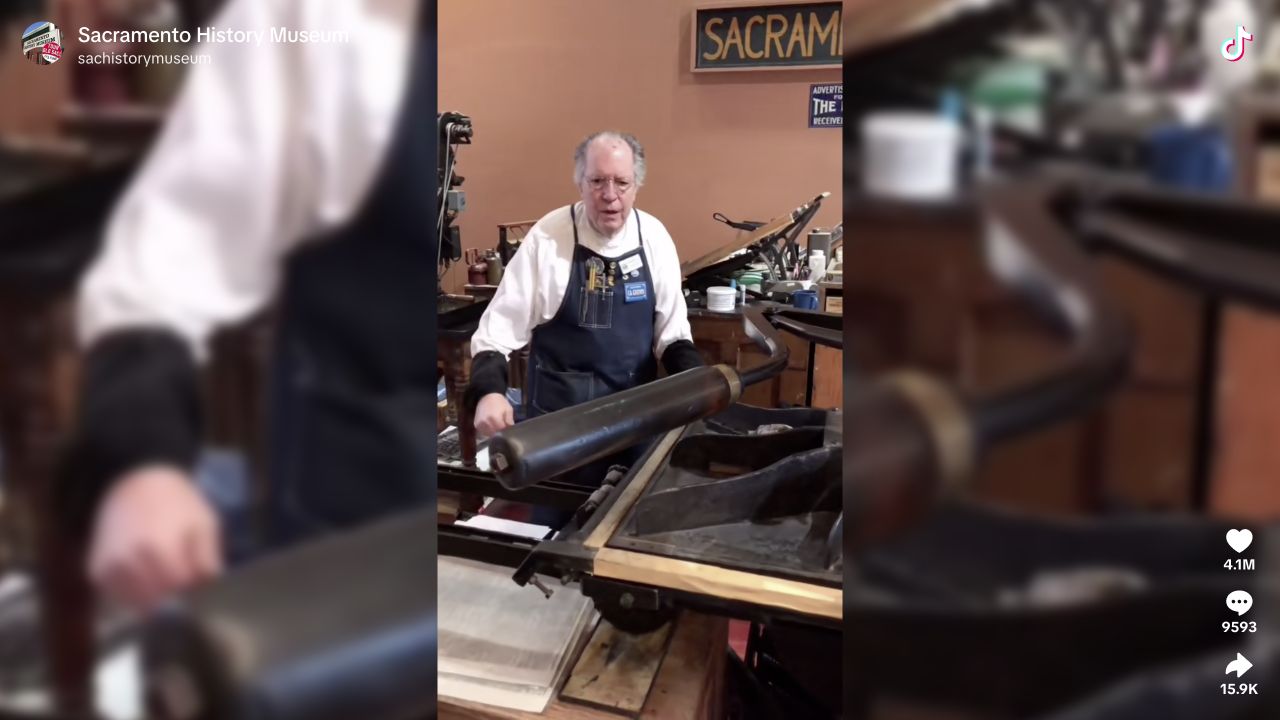
A museum turns a working process into programming
Use the post to inspect how an explanation makes something observable. Do not infer comprehension from popularity. The editorial exercise is to identify the smallest lesson that survives outside the surrounding account.
- FORMAT
- Hands-on demonstration
- PRODUCT’S ROLE
- The museum’s expertise and collection become visible through a demonstration.
Someone curious about how a physical process works.
- 01
Put expertise in the frame
Howard appears with the museum’s historic printing equipment.
Our read. The setting supplies the context that a generic educational introduction would have to explain. The operator and the object are both part of the evidence.
- 02
Let the task carry the story
The inspected footage includes close views of the printing process and press.
Our read. An observable operation gives the viewer an event to follow. For an app, a real cursor action and its consequence can do more explanatory work than a list of features.
- 03
Give the preparation a destination
After working with the type arrangement and inking equipment, Howard operates the large press.
Our read. Preparation leads to a visible action rather than a list of facts. In a software adaptation, keep that connection and show the actual output after the operation.
Film the useful part of someone’s job.
Original concept for an invoice tool. A proposal to test.
“Here is the part of an invoice I check before sending it.”
- Show on screen
- Ask a knowledgeable operator to inspect a sample invoice on screen. Let them identify one problem, correct it in the actual tool and show the updated document.
- Keep the mechanism
- A person with a specific task and an output the viewer can examine.
- Make it yours
- The environment and workflow. Borrow the demonstration structure, not Howard’s identity or the museum’s authority.
- What to record
- Look for questions about the demonstrated operation. Compare equivalent observation windows and record production time so the format’s upkeep is visible.
Source & observation notes
Howard handles the type arrangement, works beside an inking roller and metal surface, then operates a large printing press. Workshop drawers and type cases remain visible.
The practitioner, tools and sequence of physical actions provide the subject. The expertise is visible in the process.
Establishes a museum’s practitioner-led editorial subject. It cannot establish museum visits, donations or the effect of ASMR on retention.
Playback started and changing visual sequences inspected on 9 September 2026. Audio and every frame were not independently reviewed. Source checked 2026-09-09. Source 1 ↗
01STORY BRIEFThe idea in three screens.3 SCREENS
Teach something before the final slide.
An educational slideshow communicates usable knowledge during reading.
Take a narrow question: how do median and mean differ? A small, explicitly illustrative numerical example is enough. Show the calculation and the decision it changes. The last screen can suggest further reading, but earlier screens should already answer the original question.
To explain a misleading average, show a few fictional values and place the large outcome beside them. Readers can repeat the calculation and see why the conclusion changes. This verifiability makes the sequence stronger than an impressive number standing alone. It also creates a useful transition to a longer note for readers wanting more detail, while leaving the original slideshow complete on its own.
Teach a distinction the reader can use immediately.
A useful educational sequence does more than name five tips. It helps a reader tell two situations apart. For example, a low view count after a failed publication is a different problem from a low view count after a successful publication. Showing that distinction can prevent the reader from changing creative work when the operating problem has not been resolved. The teaching value lies in the decision the distinction changes.
A teachable unit
- 01Distinction
Two things the audience is likely to confuse.
- 02Example
A concrete situation that makes the difference visible.
- 03Decision
What the reader should do differently because of it.
Editorial model: a way to reason about the process, not measured platform results.
Choose one misconception, one worked example and one boundary. Put the example close to the explanation so the reader does not have to remember an abstract rule across several decorative slides. Use labels that point to the important part of an image. If the diagram contains invented numbers, say so beside the numbers. End with a question the reader can apply to their own situation. A saved post may suggest usefulness, but it does not demonstrate that people understood or applied the lesson. Keep the educational promise modest enough to fulfil inside the sequence.
The museum example is a video reference for practitioner-led explanation, not a slideshow performance case. To adapt its educational principle, use frames that reveal a real process: the tool, the material, the operation and the result. Each slide should resolve a question created by the previous one. Label the part a beginner would otherwise miss, and keep enough visual detail for someone to inspect it. The expert's specificity is the value. Replacing the process with stock images and generic tips preserves the category of educational content while removing the reason the original subject was interesting.
“Teach something before the final slide.”
02FIELD KITFrom concept to practice.2 SCREENS
Choose an answerable question.
Adapt this to your audience, budget and test scope.
Put it to work.
- 01Choose an answerable question.
- 02Include an example and a limitation.
Notes & sources.
The limit. A definition without application often leaves all useful work to the reader.
Further reading is linked throughout this article. Worked examples explain a process; they are not campaign results.
THE ORGANIC CLUB is an editorial project initiated by TokPortal. That relationship is separate from the evidence behind claims. Editorial signatures and image credits are explained in our policy. Our editorial policy →


.png)