
A Meme Slideshow builds its sequence around a cultural observation or punchline. A product can fit inside it, but cannot replace the comic mechanism.
Ryanair gives a plane a celebrity crush
The example is useful because the brand participates in a recognisable joke through its own identity. Study that relationship. Copying a caption or trending format without the cultural context would miss the mechanism being discussed.
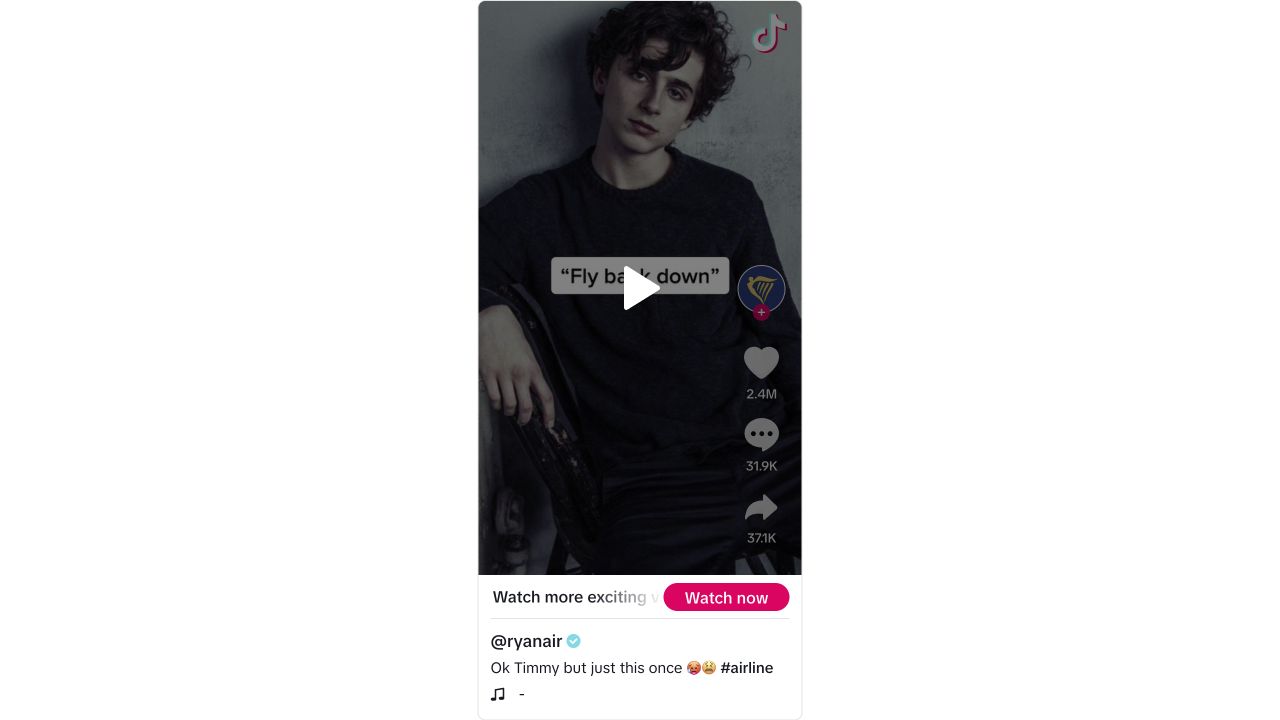
A personified Ryanair aircraft is the vehicle for a joke about Timothée Chalamet. The observed embed thumbnail shows Chalamet with the words “Fly back down”.
A familiar object can carry a consistent personality. The useful choice is the relationship between the joke and the brand, not copying a random trending sound.
Source & observation notes
Demonstrates character-based meme adaptation. It cannot prove that irreverence outperforms other tones, or that viewers became passengers.
Source-described; full video not independently watched; public embed thumbnail and identity checked Source checked 2026-09-08. Source 1 ↗
01STORY BRIEFThe idea in three screens.3 SCREENS
The joke should work without the logo.
A Meme Slideshow builds its sequence around a cultural observation or punchline.
Useful material often comes from a friction your audience instantly recognizes. Three meetings to decide to cancel one, for example. Show the text to someone in the intended audience. Ask what they recognized, not whether they liked it. Qualitative feedback helps separate resonance from politeness.
The punchline can target a habit rather than a person. A recognizable shared behavior provides material without inventing customer quotes. Keep a fictional situation’s status clear. Comic precision often comes from one convincing detail rather than a spectacular claim about how many people experience the scene. That leaves space for humor while preserving the distinction between an observation, an illustration and actual research.
Keep the cultural reference attached to the audience problem.
A meme works through shared recognition. The audience supplies part of the meaning, which can make a small image or sentence feel unusually economical. That economy disappears when a brand uses a format without understanding the situation people recognise inside it. Start by describing the joke without naming the trend. If nobody on the team can explain the tension, borrowing its appearance is unlikely to produce a coherent adaptation.
A meme adaptation with a reason to exist
- 01Recognition
The shared situation the audience brings to the joke.
- 02Twist
The specific observation your account adds.
- 03Fit
The connection to the account’s ongoing editorial promise.
Editorial model: a way to reason about the process, not measured platform results.
Try the post without the logo and without the CTA. Does the joke still land for the intended audience? Then restore the product and ask whether it adds a relevant detail or merely interrupts the punchline. Some entertaining posts can support a broader account identity without selling anything directly, but that should be an editorial choice rather than an excuse attached after the fact. Keep rights and source context in the production record. A reference can be culturally familiar while its underlying image, music or clip still requires careful handling in a commercial workflow.
The Ryanair reference is a video, and that distinction matters. Use it to examine personification and brand context, not as evidence that a slideshow version would perform the same way. To adapt the mechanism into original slides, make the first frame establish the character, the second introduce the specific tension and the last deliver a payoff that depends on the brand's situation. If the joke still works identically after replacing the airline with a shampoo bottle, it may be a generic meme with a logo attached. Keep the number of frames dictated by the joke; stretching a three-beat idea into ten cards is a remarkably efficient way to kill it.
“The joke should work without the logo.”
02FIELD KITFrom concept to practice.2 SCREENS
Start with a specific observation.
Adapt this to your audience, budget and test scope.
Put it to work.
- 01Start with a specific observation.
- 02Check rights to reused images.
Notes & sources.
The limit. A successful joke does not automatically validate product positioning.
Further reading is linked throughout this article. Worked examples explain a process; they are not campaign results.
THE ORGANIC CLUB is an editorial project initiated by TokPortal. That relationship is separate from the evidence behind claims. Editorial signatures and image credits are explained in our policy. Our editorial policy →