
An AGD inventory connects each account to its role, market, owner and observed state. It separates available assets from desired ones.
01STORY BRIEFThe idea in three screens.3 SCREENS

Your network starts with an accurate inventory.
An AGD inventory connects each account to its role, market, owner and observed state.
An account being created, an accessible account and a publishing-ready account are different states. Record last verification time instead of keeping permanent labels. Credentials belong in an appropriate manager, not an editorial sheet. The inventory describes the system without exposing its secrets.
Distinguish active, temporarily unavailable and out-of-scope accounts. Keep status-change history for retrospectives. Otherwise a disappeared account can drop out of calculations and make the network look stronger. The inventory is therefore also a measurement tool, provided each update does not rewrite the past. Current capacity answers today’s planning question; historical membership answers what happened to the original cohort and resources committed to it.
Treat the inventory as a current state, not a head count.
Counting accounts is easy; knowing which ones are ready for a specific job is harder. Record the account’s purpose, current operating status, owner and the source from which that status was confirmed. Keep identifiers stable so a renamed profile does not become a new row with a lost history. Separate editorial readiness from technical readiness: an accessible account can still lack an approved brief.
Three states worth separating
- 01Identity
The stable account record and its editorial purpose.
- 02Readiness
Whether a specific planned action can proceed now.
- 03Responsibility
The person and evidence needed to resolve an unknown.
Editorial model: a way to reason about the process, not measured platform results.
Review the inventory before allocating work, especially after a long pause or a change in provider. Avoid embedding credentials in an ordinary planning sheet. Link to the approved access process and retain only the information needed for coordination. When a job fails, update the relevant state rather than leaving a warning buried in a chat thread. A useful inventory answers what can happen next and who can resolve uncertainty. The number of rows matters less than whether the next operator can trust the record.
From the idea to the actual workflow.
Product screens, documented tools and a practical way to connect them.
Start with the accounts you actually have
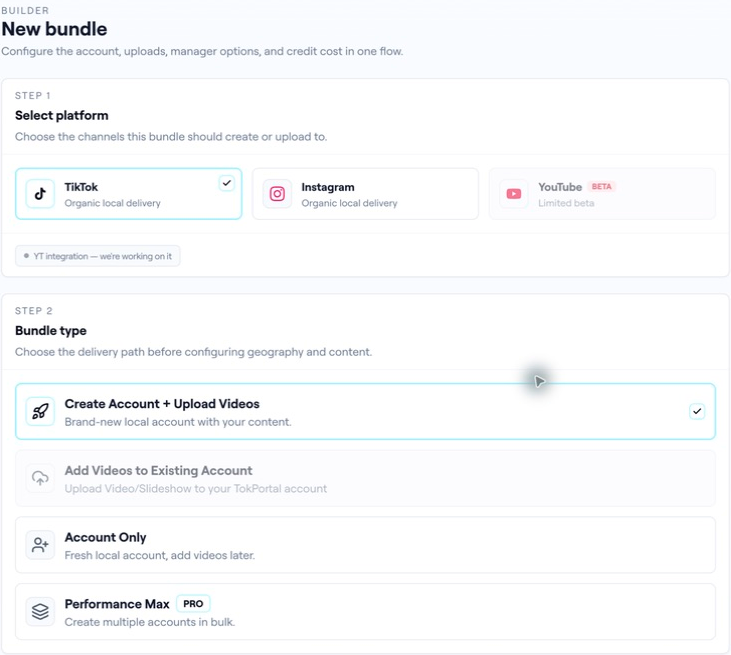
In TokPortal, a publishing plan begins with a real destination account. This read-only request narrows the inventory to TikTok accounts in the USA. It returns accounts in the connected workspace, not a catalogue of accounts for sale.
GET /api/ext/accounts{
"tool": "tokportal_list_accounts",
"arguments": {
"platform": "tiktok",
"country": "USA",
"page": 1,
"per_page": 3
}
}Before briefing three narrators, inspect the account IDs and state returned by this request. If an existing account is suitable, choose the existing-account route instead of ordering a new one.
- 01Account ID
A delivered saved_account_id differs from the stable bundle account listing ID. Use the identifier required by the next tool.
- 02Scope
Results belong to the connected workspace. An empty list is not proof that TikTok has no relevant audience.
- 03Next decision
Match each account to a distinct audience promise before assigning an asset.
“Your network starts with an accurate inventory.”
02FIELD KITFrom concept to practice.2 SCREENS
Define unambiguous states.
Adapt this to your audience, budget and test scope.
Put it to work.
- 01Define unambiguous states.
- 02Record an owner and verification date.
Notes & sources.
The limit. An outdated inventory can make an agent plan work against unavailable capacity.
Further reading is linked throughout this article. Worked examples explain a process; they are not campaign results.
THE ORGANIC CLUB is an editorial project initiated by TokPortal. That relationship is separate from the evidence behind claims. Editorial signatures and image credits are explained in our policy. Our editorial policy →



.jpg)