An agent budget defines authorized operations, limits and renewal conditions. It should distinguish immediate spending, recurring charges and estimates.
01STORY BRIEFThe idea in three screens.3 SCREENS
An agent without a ceiling has no budget.
An agent budget defines authorized operations, limits and renewal conditions.
Read current prices and account state before proposing a plan. Preview prepares a decision; authorization defines what can execute. Keep estimated and actual spending separate. A loop restarting tasks after errors should still respect the original ceiling.
An approval interface can separate immediate cost from estimated recurring commitment and identify anything not priced. A human then approves a concrete scope. If the plan changes, compare its new cost with that authorization rather than assuming the first approval covers every future extension. Preserve the original scope in the log so later retries and revisions can be assessed against the same boundary.
Budget the whole attempt, including the quiet work
An agent can make small costs feel weightless because they arrive as individual tool calls. Research, generation, retries, account operations and human review can accumulate before a single useful post exists. Define a budget at the campaign or experiment level and reserve room for the work needed to finish it. Track committed and pending spend separately from completed charges where the underlying service exposes those states. A dashboard that counts only settled costs can overstate how much authority remains available.
Three budgets that should agree
- 01Authorised
The maximum scope the operator approved.
- 02Committed
Pending work that can still create charges.
- 03Consumed
Completed spend and human effort already used.
Editorial model: a way to reason about the process, not measured platform results.
Put enforceable limits close to the tools that spend money. A prompt asking the agent to be careful is not a substitute for maximum quantities, approved operation types and a stop condition. Before expanding the batch, compare what the previous attempts taught with what the next spend is intended to resolve. Include human production time in the retrospective even when it never appears on an API invoice. The useful unit is the cost of a completed learning cycle or qualified outcome, not the price of one apparently cheap generation.
From the idea to the actual workflow.
Product screens, documented tools and a practical way to connect them.
Preview an account with three video slots before committing credits
The archived builder shows account and video-package choices. This sample MCP request previews a package with one account and three video slots; it does not upload three video files.
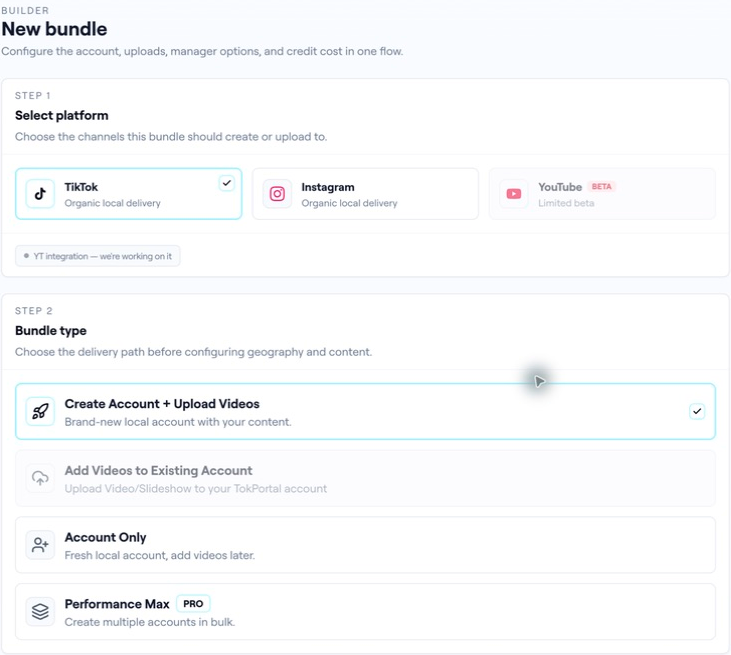
POST /api/ext/bundles{
"tool": "tokportal_create_bundle",
"arguments": {
"dry_run": true,
"body": {
"bundle_type": "account_and_videos",
"platform": "tiktok",
"country": "USA",
"videos_quantity": 3,
"edits_quantity": 0,
"wants_advanced_warming": false,
"auto_finalize_videos": false
}
}
}This is a sample request, not an executed order or a price quote. In REST, the equivalent simulation uses X-TokPortal-Dry-Run: true. Live creation debits credits immediately; the preview is the place to inspect the actual workspace-specific price.
- 01Read the quote
Read the quoted credit fields and cost_breakdown returned by the current contract. A simulation does not debit the live balance.
- 02Keep simulation separate
Returned simulation IDs are synthetic and cannot be reused in live requests. The simulation does not retain cross-call objects.
- 03Review the package
auto_finalize_videos is explicitly false here. Check the current review-window rules before any live execution.
“An agent without a ceiling has no budget.”
02FIELD KITFrom concept to practice.2 SCREENS
Define scope, ceiling and duration.
Adapt this to your audience, budget and test scope.
Put it to work.
- 01Define scope, ceiling and duration.
- 02Stop mutations when the limit is reached.
Notes & sources.
The limit. An available balance is not authorization to spend all of it.
Further reading is linked throughout this article. Worked examples explain a process; they are not campaign results.
THE ORGANIC CLUB is an editorial project initiated by TokPortal. That relationship is separate from the evidence behind claims. Editorial signatures and image credits are explained in our policy. Our editorial policy →