
Creative clustering groups content under chosen criteria. Groups should be interpretable and checked before informing allocation.
One LEGO set, several fashion interpretations
The public post can be tagged by its mechanism. A visual resemblance alone does not make another clip the same creative hypothesis.
- FORMAT
- Object → visual reinterpretation
- PRODUCT’S ROLE
- LEGO objects provide the visual source material for the fashion idea.

A viewer who enjoys recognising an object in a surprising new form.
- 01
Make the reference recognisable
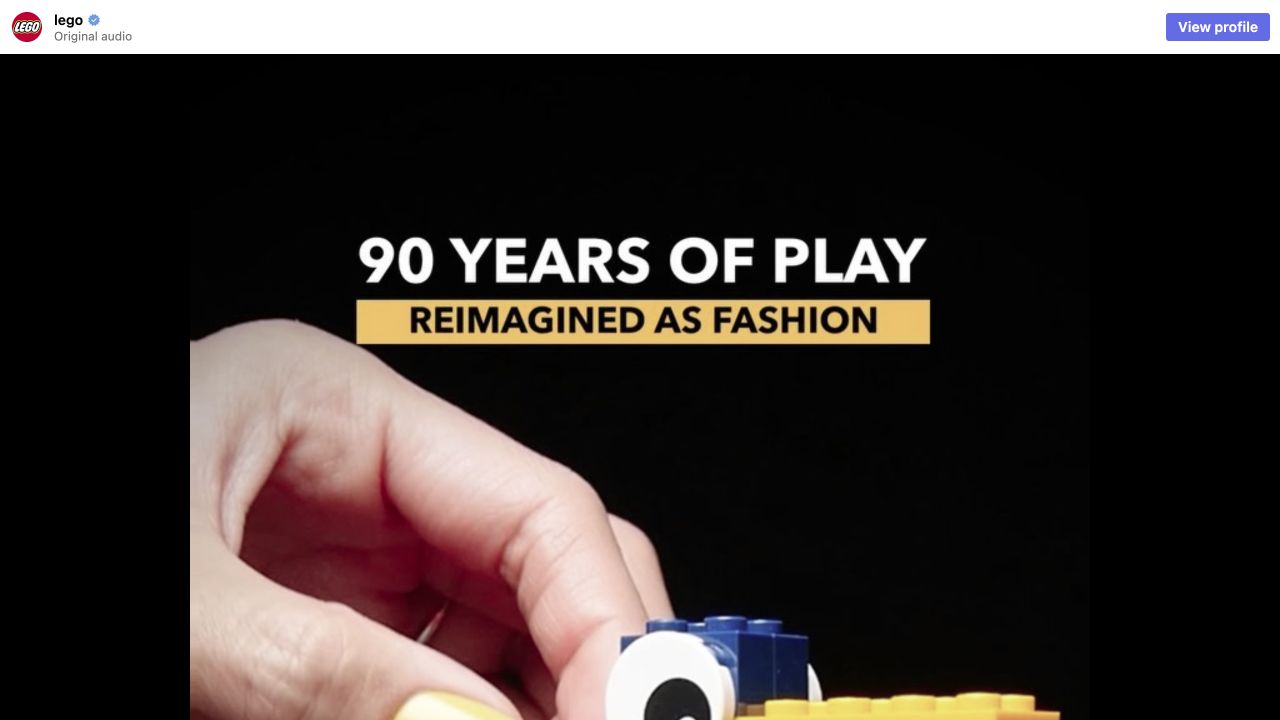
The Reel shows a small LEGO duck with a long yellow beak and coloured body.
Our read. A transformation only rewards recognition when the original is clear. If the viewer cannot identify the source, the reveal loses the comparison that makes it satisfying.
- 02
Carry a few cues across
The inspected Reel moves between LEGO objects and fashion imagery.
Our read. The useful exercise is choosing which colours, shapes or proportions survive the change of medium. Randomly changing the backdrop would not create the same relationship.
- 03
Make the difference visible
The saved fashion frame makes the reinterpretation available for comparison with the toy.
Our read. A second version can earn attention by explaining a new aspect of the same source. That is a more useful creative distinction than counting exports from one template.
One product, three different proof devices.
Original concepts for a voice-notes app. A proposal to test.
“The same messy idea, rescued three ways.”
- Show on screen
- Use one recording you own. Make a tutorial that shows the operation, a before-and-after that shows the cleaned note, and a short scene that shows somebody using the note later. Label these as separate concepts in the creative sheet.
- Keep the mechanism
- A shared source and a difference the viewer can actually recognise.
- Make it yours
- What the viewer learns from each version. A new font, actor or colour alone is not a new use case.
- What to record
- Give concepts and versions different IDs. Review audience questions and downstream actions by concept before choosing a cosmetic winner.
Source & observation notes
A wheeled multicolor LEGO duck is followed by a model in a blue/yellow/red block-color dress and white glasses. Later observed a red dress with an orange belt and a green top with black skirt and jacket.
The first visible transition translates the toy’s recognizable colors into clothing, giving a clear visual connection between source object and reinterpretation.
Verifies a Reel on LEGO’s official account and the reported fashion premise. It does not verify sales, audience overlap, organic-only distribution or a causal benefit from format diversification.
Playback started and changing visual sequences inspected on 9 September 2026. Audio and every frame were not independently reviewed. Source checked 2026-09-09. Source 1 ↗
01STORY BRIEFThe idea in three screens.3 SCREENS

Group ideas without erasing their differences.
Creative clustering groups content under chosen criteria.
A model may group videos by background while their promises differ. Define angle, format and situation. Review a sample of human-machine disagreements. The goal is not a perfect taxonomy but recoverable, useful creative decisions.
Use a few annotated examples as references and retain cases belonging to several groups. An ambiguous category is better than artificial precision. If the agent mostly classifies scenery, rewrite the instruction around the problem addressed. Grouping should help retrieve ideas rather than merely fill a metadata column. A small review set can reveal whether the labels preserve useful distinctions across genuinely different creative treatments.
Let the machine organise; keep the labels interpretable
Clustering can help a team find repeated ideas in a large creative library, but a cluster is not automatically a meaningful strategy category. Similar colours or wording may pull together posts that solve different audience problems. Inspect representative items and name the group in terms an editor can use: objection handled, proof shown, narrative structure or product use case. Keep the original metadata and allow manual corrections. If nobody can explain why two posts belong together, the cluster is difficult to turn into a useful brief.
From similarity to an editorial decision
- 01Group
Find candidate patterns without treating them as truth.
- 02Label
Name the audience problem or creative mechanism.
- 03Inspect
Review exceptions and compare like conditions.
Editorial model: a way to reason about the process, not measured platform results.
Use the groups to find gaps and concentration, not to declare causal winners. A high-performing cluster may contain older posts, stronger accounts or a different observation window. Compare those factors before attributing outcomes to the creative pattern. Preserve a place for outliers rather than forcing every unusual idea into the nearest familiar bucket. The library should make it easier to discover a fresh question, not only to reproduce the most common visual style. Review the labels as the editorial programme changes; yesterday's useful taxonomy can become today's blind spot.
The LEGO Reel can sit in more than one sensible editorial group: product reinterpretation, fashion collaboration or visual analogy. That is a reminder that a cluster depends on the question being asked. If the library is meant to inspire product demonstrations, label the transformation of source material. If it is meant to study collaborations, label what the second creative world contributes. Keep both tags when useful rather than forcing one universal taxonomy. A machine can propose these relationships, but an editor should be able to explain why a future brief would benefit from seeing the reference.
“Group ideas without erasing their differences.”
02FIELD KITFrom concept to practice.2 SCREENS
Define each classification dimension.
Adapt this to your audience, budget and test scope.
Put it to work.
- 01Define each classification dimension.
- 02Review ambiguous cases.
Notes & sources.
The limit. Visual similarity does not prove similar intent or audience.
Further reading is linked throughout this article. Worked examples explain a process; they are not campaign results.
THE ORGANIC CLUB is an editorial project initiated by TokPortal. That relationship is separate from the evidence behind claims. Editorial signatures and image credits are explained in our policy. Our editorial policy →




.jpg)