Comparing Native Posting with API publishing requires comparable cohorts and identical observation windows. This note reports no experimental result: the verdict remains unknown.
01STORY BRIEFThe idea in three screens.3 SCREENS
An operational preference is not a law of the algorithm.
“APIs kill reach.” Here is the protocol that claim would need.
Two screenshots do not make an experiment. An established account posts natively, a new account uses an API, and someone attributes the gap to the upload method. Age, followers, topic and editing quality disappear from the story.
The protocol starts before publication: define eligible accounts, formats, countries and observation windows. Allocate treatments within comparable blocks and retain technical failures. An analysis restricted to successful publications would answer a different question.
Available native features can differ from an integration’s capabilities. Separate two tests: with identical content and features, does the publishing channel change results? And in actual use, does access to native tools change the performance of the complete workflow?
TokPortal illustrates the separation between API orchestration and human execution inside consumer apps. That describes an architecture; it does not prove algorithmic superiority. A conclusion would need a verifiable method and observations.
Separate the upload route from the creative package.
Imagine two posts described as a native-versus-API test. One uses a current sound, an in-app effect and a reply to a comment. The other is a silent export uploaded through a generic workflow. A difference in results would not isolate the upload route. The viewer received different content, and the team may also have chosen different accounts or publishing windows. Before running the comparison, write down every feature available in each workflow and decide which differences belong in the question you are asking.
One comparison, three possible explanations
- 01Route
Where and how the publishing action happened.
- 02Features
What sounds, replies, effects or formats the viewer received.
- 03Context
Which account, audience and observation window were involved.
Editorial model: a way to reason about the process, not measured platform results.
There are legitimate operational reasons to choose native execution: access to a particular creation surface, an operator’s ability to inspect the final preview, or a workflow the platform exposes only in its own app. Those are capability claims, not evidence of an automatic reach bonus. A useful pilot records the final asset, account context, feature set, publication status and observation window. It also accepts an inconclusive result. If the team cannot hold the creative package reasonably comparable, report the comparison as two production workflows rather than a verdict on an invisible algorithmic preference.
Make a capability table for the actual publishing task before choosing a route. Does this post need a particular in-app effect, an authorised commercial sound, a collaboration setting or an interactive element? Can the supported API perform that operation for this account today? Which steps still require an operator, and how will completion be verified? A plain video upload and a feature-rich native post are different packages. Comparing them without listing those differences lets a technical preference masquerade as an explanation of audience response.
A sensible operation can use more than one route. An API may be appropriate for a supported, repeatable task; an authorised native workflow may be appropriate when a necessary feature is not exposed through that interface. The choice should follow the creative requirements, reliability and cost. Keep a dated record of the capability decision because platform interfaces change. TokPortal's infrastructure is relevant to the execution side of that choice, but its availability does not establish that a native route receives an algorithmic bonus. To investigate distribution, design a comparison that separates the route from the creative features and account histories travelling with it.
From the idea to the actual workflow.
Product screens, documented tools and a practical way to connect them.
Prepare the actual video slot, not just the caption
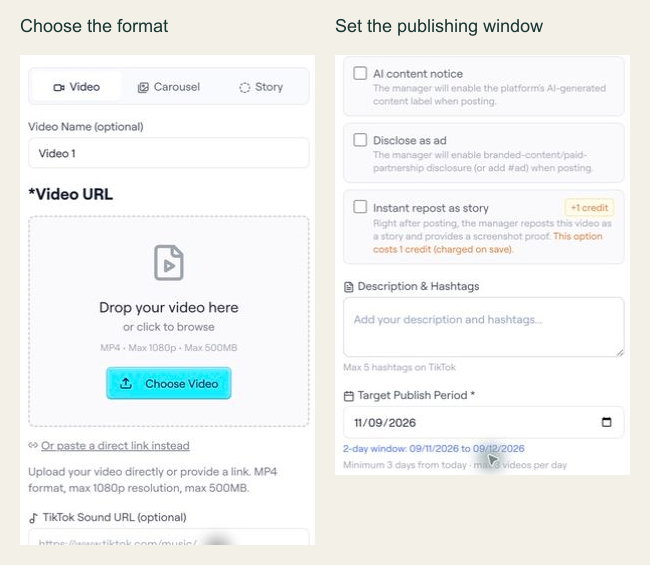
In the archived editor capture, the interface shows Video, Carousel and Story options, plus a target publishing period. The API example below is a separate documented slot-configuration preview; the screenshot alone does not establish the API contract.
PUT /api/ext/bundles/{id}/videos/{position}{
"tool": "tokportal_configure_bundle_video",
"arguments": {
"id": "<real-bundle-uuid>",
"position": 1,
"body": {
"video_type": "video",
"video_url": "<public_url returned by your video upload>",
"description": "A practical example of organising freelance subscriptions.",
"target_publish_date": "<valid future date: YYYY-MM-DD>",
"ai_content_disclaimer": false,
"auto_publish": false
},
"dry_run": true
}
}Replace the marked values with an authorized real bundle, a media URL you control and a valid future date. This is a dry-run template, not an executed campaign. The archived UI shows a two-day period for that captured example; use the current API validation response to determine the dates accepted for your own request.
- 01Choose the correct media fields
A video needs video_url and description. A TikTok carousel instead needs carousel_images and tiktok_sound_url.
- 02Use a valid window
Allow at least three days while account creation is pending, or one day for delivered/existing accounts. Check the current response and limits.
- 03Read the preview result
Check the simulation markers and date validation. If INVALID_DATE includes details.earliest_allowed, use that returned limit to revise the proposed date. Never copy preview IDs into live requests.
“An operational preference is not a law of the algorithm.”
02FIELD KITFrom concept to practice.3 SCREENS
Preregister cohorts, primary metric and observation window.
Adapt this to your audience, budget and test scope.
Put it to work.
- 01Preregister cohorts, primary metric and observation window.
- 02Keep failures in the relevant denominator.
- 03Report median, dispersion and uncertainty.
Notes & sources.
The limit. Attributing a creative or account-age difference to the publishing channel.
- developers.tiktok.com/doc/content-posting-api-get-started/ · consulted September 8, 2026
- developers.tokportal.com/ · consulted September 8, 2026
THE ORGANIC CLUB is an editorial project initiated by TokPortal. That relationship is separate from the evidence behind claims. Editorial signatures and image credits are explained in our policy. Our editorial policy →