
Account Isolation is the AGD principle that gives every account a sufficiently distinct identity, audience and purpose to operate as an independent editorial surface.
01STORY BRIEFThe idea in three screens.3 SCREENS

Another account is only useful when it brings another perspective.
Account Isolation: differentiate the voices before multiplying the profiles.
A different avatar does not create a new audience. If every account describes the same product with the same humor for the same people, you have mostly multiplied the credentials to manage. The network exists technically; its editorial logic is still missing.
Consider a note-taking app. One account can cover lectures, another fiction writing, another meeting notes. The demonstrations share a product, but their situations, references and success criteria change. That distance makes the experiments readable.
Write three sentences for each account: who it addresses, what it promises and what it refuses to publish. The last one does the most work. It stops every success elsewhere in the network from becoming an instruction to copy.
Isolation here is not a method for hiding account relationships or bypassing enforcement. It concerns distribution diversity. An audience that understands who is speaking is a more durable asset than infrastructure designed to remain incomprehensible.
Write the refusal before the publishing plan.
The most useful line in an account brief may be the one beginning “we do not”. An account teaching students to organise lecture notes does not publish generic founder motivation. An account helping managers prepare meetings does not suddenly become a campus meme page because a joke performed well elsewhere. These refusals protect an audience promise. Without them, every promising result in the network becomes a reason to make the accounts converge, until their supposed diversity consists of profile pictures and passwords.
An account brief with actual boundaries
- 01For
A precise viewer and the recurring situation they face.
- 02Because
The useful promise a follower can describe to a friend.
- 03Never
The tempting content this account deliberately refuses.
Editorial model: a way to reason about the process, not measured platform results.
Run a small editorial sorting exercise before scaling. Place recent posts from several accounts in one folder without names. Ask a teammate to group them by intended viewer and situation. Discuss the ambiguous posts, rather than treating the exercise as a scientific score. Then compare the language of genuine audience responses. Are viewers asking distinct questions, or are the same vague reactions appearing everywhere? Neither exercise proves that platforms reward isolation. They help you decide whether the network contains different editorial assets, which is the version of isolation worth building around.
Try writing the reason to follow each account on separate cards. One might promise practical editing breakdowns, another might explain the economics of creator tools, and a third might document a particular learning project. Now assign ten proposed posts. If every post fits every card equally well, the accounts are not yet differentiated. If one card cannot support a useful post without borrowing the other two accounts' material, its editorial role may be too thin. This exercise costs less than opening another production queue and makes the eventual account brief much easier to write.
The boundary should also help the operator make exclusions. A joke can be excellent and still belong elsewhere. An offer can be relevant to the business and irrelevant to the audience that followed this account. Keep those decisions in the brief so a new editor does not have to reconstruct them from a mood board. Review audience responses for evidence that the promise is understood, while remembering that commenters are a selective part of the audience. Account isolation is successful as an editorial practice when it produces distinct, understandable reasons to follow. It is not a claim that accounts can be made invisible to platform systems or immune to shared operational risks.
From the idea to the actual workflow.
Product screens, documented tools and a practical way to connect them.
Start with the accounts you actually have
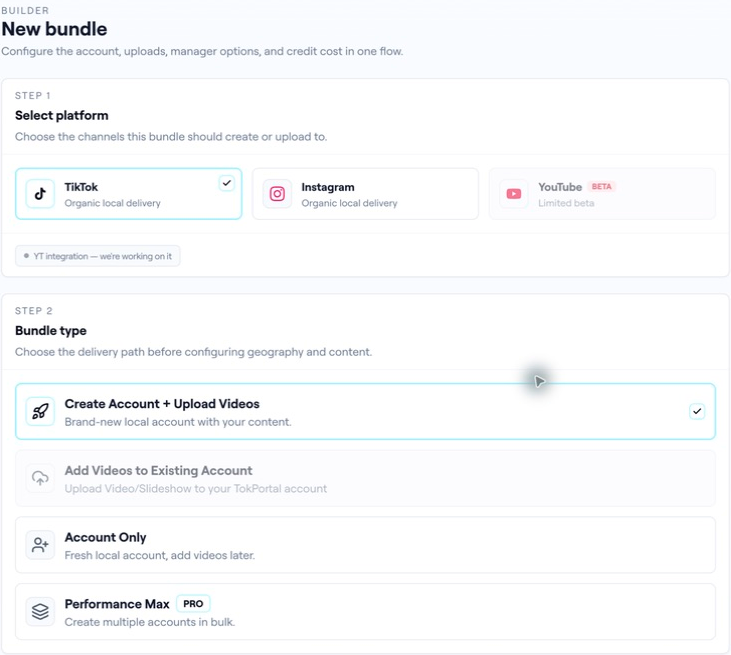
In TokPortal, a publishing plan begins with a real destination account. This read-only request narrows the inventory to TikTok accounts in the USA. It returns accounts in the connected workspace, not a catalogue of accounts for sale.
GET /api/ext/accounts{
"tool": "tokportal_list_accounts",
"arguments": {
"platform": "tiktok",
"country": "USA",
"page": 1,
"per_page": 3
}
}Before briefing three narrators, inspect the account IDs and state returned by this request. If an existing account is suitable, choose the existing-account route instead of ordering a new one.
- 01Account ID
A delivered saved_account_id differs from the stable bundle account listing ID. Use the identifier required by the next tool.
- 02Scope
Results belong to the connected workspace. An empty list is not proof that TikTok has no relevant audience.
- 03Next decision
Match each account to a distinct audience promise before assigning an asset.
“Another account is only useful when it brings another perspective.”
02FIELD KITFrom concept to practice.3 SCREENS
Define an audience, a promise and a refusal for each account.
Adapt this to your audience, budget and test scope.
Put it to work.
- 01Define an audience, a promise and a refusal for each account.
- 02Compare comments for genuinely different uses.
- 03Revise accounts whose roles overlap.
Notes & sources.
The limit. Editorial differentiation should not be confused with technical concealment.
Further reading is linked throughout this article. Worked examples explain a process; they are not campaign results.
THE ORGANIC CLUB is an editorial project initiated by TokPortal. That relationship is separate from the evidence behind claims. Editorial signatures and image credits are explained in our policy. Our editorial policy →