
A Multi-Account Strategy distributes a brand’s experiments across differentiated accounts. It is AGD’s organizational foundation, not its complete definition.
A repeatable lunch becomes a repeatable content idea
Read the example as one editorial promise expressed in a post. For your own network, describe the different promise another account would make. The public example does not establish that multiplying accounts would reproduce its outcome.
- FORMAT
- Process → finished result → use
- PRODUCT’S ROLE
- The meal is demonstrated and used. A software adaptation needs its own visible proof.
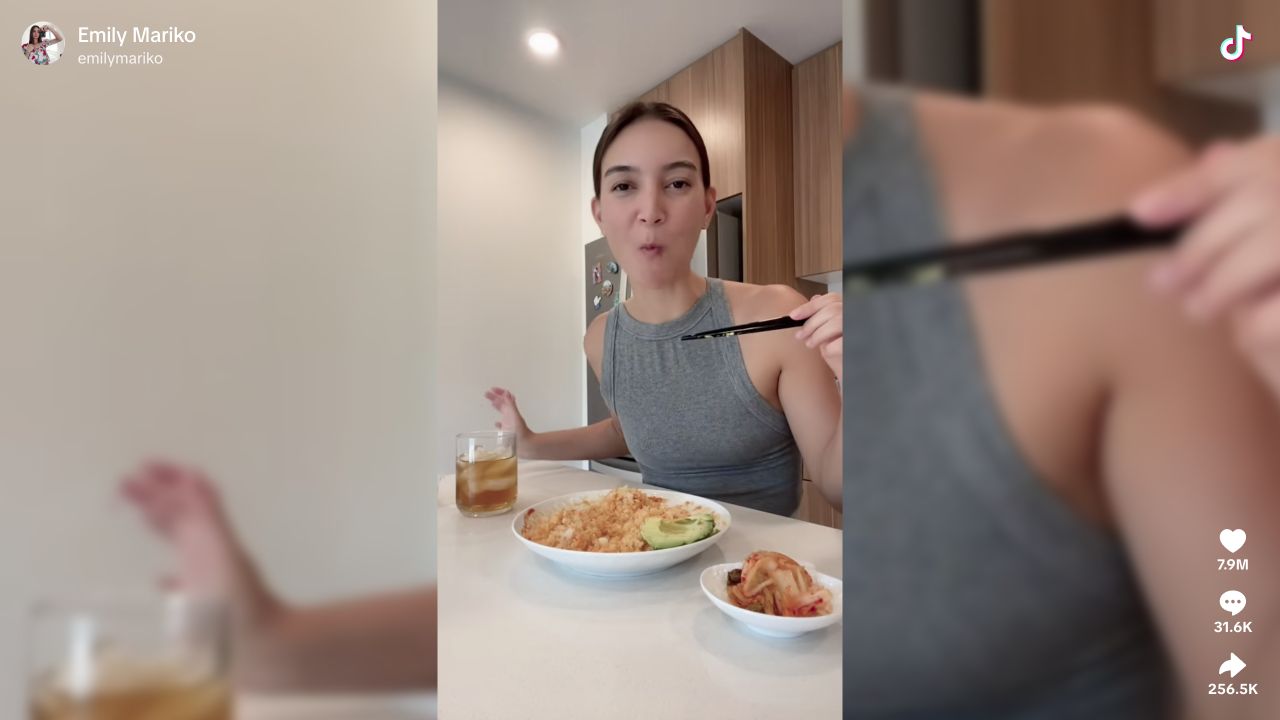
Someone who wants a practical idea for making lunch.
- 01
Give the process a subject
The cooking sequence works with salmon and rice, alongside kitchen preparation.
Our read. Ingredients give the viewer something concrete to follow. For a software demo, start with the actual input: a document, a messy list or a task the audience already recognises.
- 02
Show the transformation
The inspected sequence includes microwave use, avocado preparation and assembly of the bowl.
Our read. The sequence earns its finish through intermediate actions. Removing every step may make a video shorter while also removing the evidence that makes its promise credible.
- 03
Use what you made
Emily eats from the completed bowl, with kimchi visible on the table.
Our read. The closing action answers the practical question. A product demo can do the same by using the output to complete a task, rather than ending on the tool’s logo.
Finish the job on camera.
Original concept for a subscription tracker. A proposal to test.
“I checked which subscriptions I was still paying for.”
- Show on screen
- Use a sample account you own. Show the recurring-charge list, find one forgotten test subscription and demonstrate where a person would manage it. Keep sensitive account details out of the recording.
- Keep the mechanism
- A recognisable starting mess and a final action that resolves it.
- Make it yours
- The audience problem and the proof. A cooking clip is a structural reference, not a finance testimonial.
- What to record
- Log the destination post and the same observation age for each version. Distinguish completion of the video from clicks or actions in the product.
Source & observation notes
Observed refrigerator/freezer access, microwave action, rice over pieces of salmon, avocado being cut, and the finished bowl served with kimchi while Emily eats with chopsticks.
A practical transformation progresses from ingredients to a finished meal. The final eating scene makes the promised result visible.
Documents one recipe demonstration. It cannot establish the number of people who cooked it or purchased ingredients because of it.
Playback started and changing visual sequences inspected on 9 September 2026. Audio and every frame were not independently reviewed. Source checked 2026-09-09. Source 1 ↗
01STORY BRIEFThe idea in three screens.3 SCREENS

One brand account cannot carry everything.
A Multi-Account Strategy distributes a brand’s experiments across differentiated accounts.
Separate reasons to watch before allocating posts. A cooking app can cover student meals, Sunday preparation and chef techniques. The same recipe does not fulfill all three promises. Extra operating cost should buy learning, not merely more calendar slots.
Consider two accounts covering different uses of a notes tool and a third documenting onboarding. After a cycle, compare the questions each receives. If all attract exactly the same requests, revisit their promises before creating a fourth profile. The next account should address an identified gap. Account count is an input to this decision, not evidence that the architecture works.
Split the audience problem before splitting the workload.
An easy way to waste a network is to give every account the same product brief and ask for a different tone. Sarcastic, friendly and authoritative are not necessarily different reasons to watch. Start with moments instead. A budgeting app might help someone moving out for the first time, a freelancer waiting for invoices, or a couple planning a shared expense. Each situation changes what a useful demonstration looks like. It also changes the questions that should count as qualified interest.
A reason to add another account
- 01Distinct need
A viewer problem the existing account does not serve well.
- 02Distinct format
A repeatable way to make that problem visible.
- 03Distinct learning
A question the additional account can answer.
Editorial model: a way to reason about the process, not measured platform results.
Keep the first allocation small enough that someone can actually compare the accounts. Assign an owner to each editorial promise, document which formats belong there and agree on the signal that would justify another account. That signal might be a clearly different use case appearing repeatedly in comments or a creative format that cannot coexist with the current account’s promise. It should not simply be spare production capacity. More accounts create review, access, rights and measurement work even when the posting action is cheap. Include that work in the decision to expand.
For a first TikTok test, write three briefs before opening three accounts. Imagine a subscription tracker: one brief teaches a freelancer to spot forgotten recurring expenses; another shows two flatmates settling a shared bill; a third turns a confusing bank statement into a one-minute audit. This is a proposed test, not a campaign we ran. Each brief needs its own visible problem, demonstration and next step. If all three scripts end up saying ‘save money with our app’, the account split has not bought you a meaningful distinction.
Now make the promise repeatable. Emily Mariko’s cooking post below is useful because the process is visible: preparation leads to a finished meal and then to eating it. Study that sequence rather than copying the dish or assuming her audience will transfer to your product. A finance demonstration needs its own equivalent: show the subscription list, expose the forgotten payment, then show the action that removes it. Keep a rights-cleared recording of your own product, with no customer details in view. A satisfying reveal is something you can design; a million views is not something you can put in a brief.
Use one small batch to check whether this system is operable. Record the account, concept ID, original asset, publication URL and observation date in a sheet. Compare posts at a common age, and keep missing metrics blank rather than entering zero. Read comments for the problem people actually recognise: ‘I forgot that charge too’ is more specific than a generic emoji. The TokPortal inventory and video-slot examples below show where destinations and publishing inputs become explicit. They help organise execution; they do not establish that three accounts outperform one. Expand only when a distinct audience promise and the work of maintaining it both make sense.
From the idea to the actual workflow.
Product screens, documented tools and a practical way to connect them.
Start with the accounts you actually have
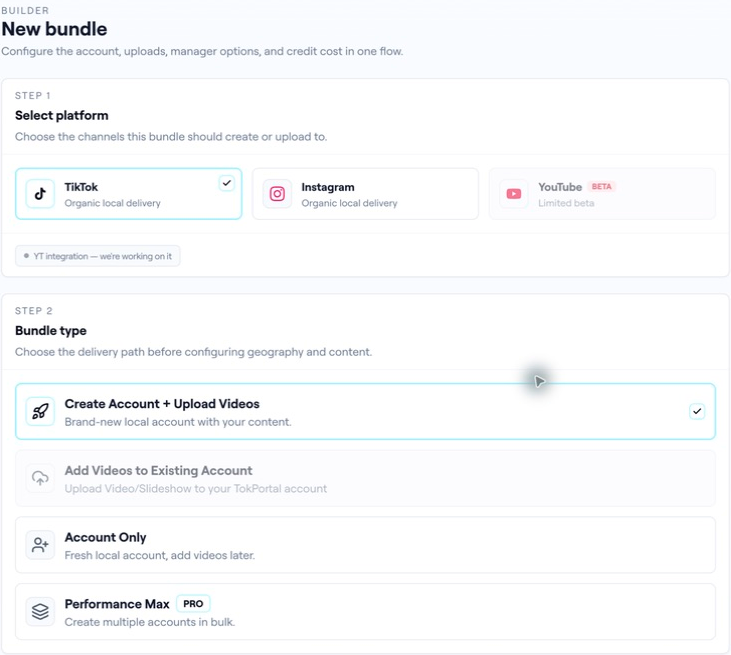
In TokPortal, a publishing plan begins with a real destination account. This read-only request narrows the inventory to TikTok accounts in the USA. It returns accounts in the connected workspace, not a catalogue of accounts for sale.
GET /api/ext/accounts{
"tool": "tokportal_list_accounts",
"arguments": {
"platform": "tiktok",
"country": "USA",
"page": 1,
"per_page": 3
}
}Before briefing three narrators, inspect the account IDs and state returned by this request. If an existing account is suitable, choose the existing-account route instead of ordering a new one.
- 01Account ID
A delivered saved_account_id differs from the stable bundle account listing ID. Use the identifier required by the next tool.
- 02Scope
Results belong to the connected workspace. An empty list is not proof that TikTok has no relevant audience.
- 03Next decision
Match each account to a distinct audience promise before assigning an asset.
Prepare the actual video slot, not just the caption
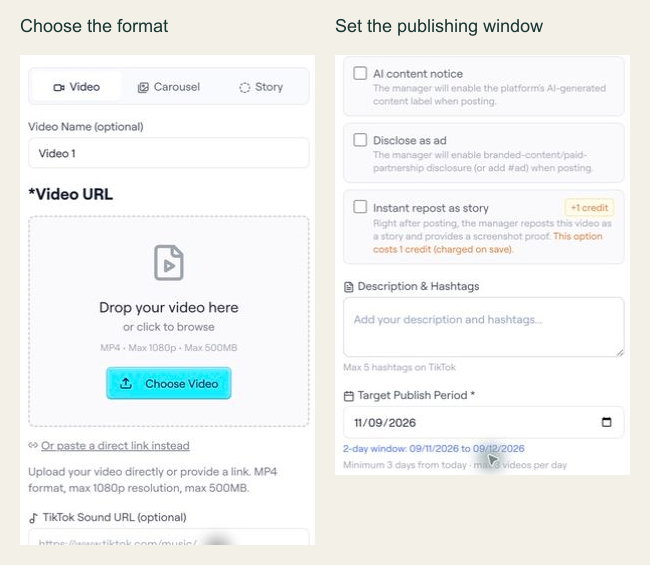
In the archived editor capture, the interface shows Video, Carousel and Story options, plus a target publishing period. The API example below is a separate documented slot-configuration preview; the screenshot alone does not establish the API contract.
PUT /api/ext/bundles/{id}/videos/{position}{
"tool": "tokportal_configure_bundle_video",
"arguments": {
"id": "<real-bundle-uuid>",
"position": 1,
"body": {
"video_type": "video",
"video_url": "<public_url returned by your video upload>",
"description": "A practical example of organising freelance subscriptions.",
"target_publish_date": "<valid future date: YYYY-MM-DD>",
"ai_content_disclaimer": false,
"auto_publish": false
},
"dry_run": true
}
}Replace the marked values with an authorized real bundle, a media URL you control and a valid future date. This is a dry-run template, not an executed campaign. The archived UI shows a two-day period for that captured example; use the current API validation response to determine the dates accepted for your own request.
- 01Choose the correct media fields
A video needs video_url and description. A TikTok carousel instead needs carousel_images and tiktok_sound_url.
- 02Use a valid window
Allow at least three days while account creation is pending, or one day for delivered/existing accounts. Check the current response and limits.
- 03Read the preview result
Check the simulation markers and date validation. If INVALID_DATE includes details.earliest_allowed, use that returned limit to revise the proposed date. Never copy preview IDs into live requests.
“One brand account cannot carry everything.”
02FIELD KITFrom concept to practice.2 SCREENS
Map three audiences and a suitable format for each.
Adapt this to your audience, budget and test scope.
Put it to work.
- 01Map three audiences and a suitable format for each.
- 02Assign an owner to every account.
Notes & sources.
The limit. Extra accounts without distinct hypotheses make analysis noisier.
Further reading is linked throughout this article. Worked examples explain a process; they are not campaign results.
THE ORGANIC CLUB is an editorial project initiated by TokPortal. That relationship is separate from the evidence behind claims. Editorial signatures and image credits are explained in our policy. Our editorial policy →